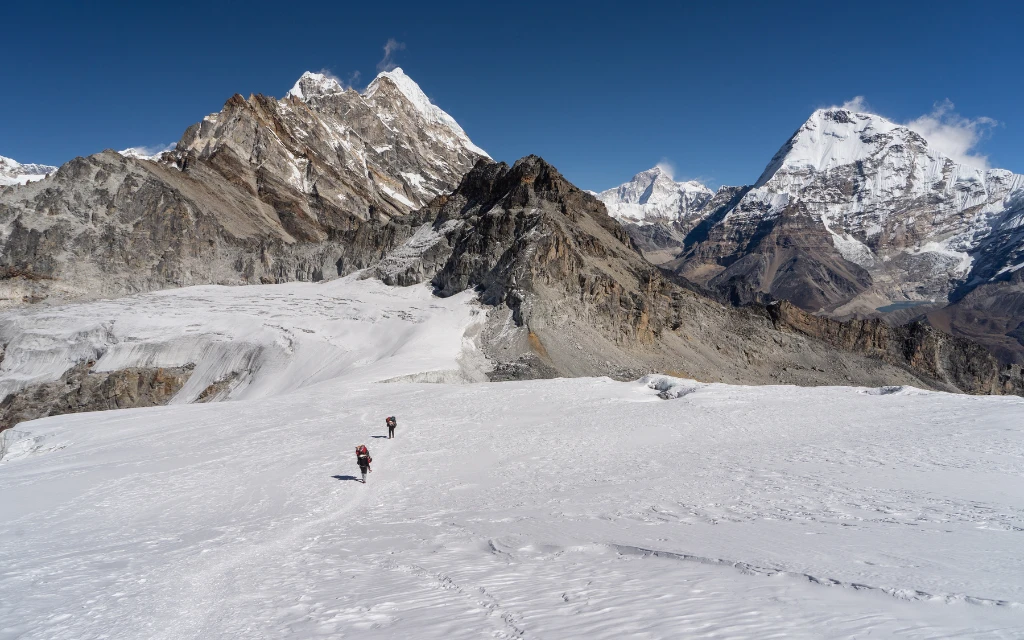
Mera Peak Climbing via Amphu Lapcha Pass is not just a trekking package; it’s a full Himalayan expedition designed for those who want more than a straightforward summit. This journey combines high-altitude trekking, technical mountaineering, remote wilderness, and one of Nepal’s most dramatic passes into a single, unforgettable adventure.
Standing at 6,476 meters, Mera Peak is the highest trekking peak in Nepal. From its summit, the panorama is extraordinary. On a clear day, you’ll witness five of the world’s highest mountains, Mount Everest, Lhotse, Makalu, Cho Oyu, and Kanchenjunga rising above a sea of Himalayan giants. It’s a summit that feels both accessible and deeply rewarding.
But what truly sets this itinerary apart is the crossing of Amphu Lapcha Pass (5,845m). Mera Peak Climbing via Amphu Lapcha Pass is a wild, glaciated pass that connects the remote Hinku Valley with the upper Khumbu region. Amphu Lapcha is dramatic, technical, and raw. It involves fixed ropes, glacier travel, and careful navigation, transforming your trek into a genuine alpine experience. It’s not just about reaching the top; it’s about earning every step of the journey.
The expedition begins with a scenic flight to Lukla and gradually enters the isolated Hinku Valley, where trails are quieter and landscapes feel untouched. You’ll walk through dense rhododendron forests, cross high yak pastures, and move steadily above the tree line into a world of ice and rock. Acclimatization days are carefully built into the itinerary to ensure safety and performance at altitude. Our climbing guides provide technical training before the summit push, equipping you with the skills needed for rope work, crampon use, and glacier movement.
Summit day on Mera Peak is a powerful experience. The climb itself is physically demanding but technically moderate, making it ideal for trekkers who want to step into mountaineering without committing to highly technical climbs. The final stretch over snow slopes feels surreal quiet, vast, and humbling. Reaching the summit at sunrise, surrounded by the tallest peaks on Earth, is a moment that stays with you long after you descend.
Mera Peak Climbing via Amphu Lapcha Pass still continues with the crossing of Amphu Lapcha Pass, leading toward the iconic Khumbu region. This eventually connects with trails that approach Everest Base Camp territory. This transition from remote wilderness to the legendary Everest landscape adds a dramatic finale to the expedition.
This package is ideal for experienced trekkers seeking a challenge beyond classic trekking routes. It requires strong physical fitness, prior high-altitude experience, and a willingness to step outside comfort zones. In return, it offers solitude, technical growth, and one of Nepal’s most complete alpine journeys.
Mera Peak Climbing via Amphu Lapcha Pass is for those who want the Himalayas in their rawest form, fewer crowds, bigger challenges, and a summit earned through true adventure.
Why Choose Us for Mera Peak Climbing via Amphu Lapcha Pass?
Mera Peak via Amphu Lapcha Pass is not a standard trekking peak itinerary. It is a serious alpine journey that combines remote trekking, glacier travel, and a technical high pass before the summit of Mera Peak. Choosing the right team is not just about comfort; it directly affects your safety, success rate, and overall mountain experience. Here is what sets us apart.
- We specialize in remote and technical Himalayan routes, including the demanding crossing of Amphu Lapcha Pass, where rope work, ice travel, and careful logistics are essential.
- Our climbing guides are experienced, certified, and locally trained professionals with extensive high-altitude experience in the Everest and Makalu regions. They understand not just the terrain but also the weather patterns, glacier conditions, and risk management required for this route.
- We maintain a high guide-to-client ratio to ensure personalized attention, safer glacier movement, and better support during the summit push.
- Our itinerary is designed for proper acclimatization. We prioritize your health and safety over speed, significantly improving summit success while reducing altitude-related risks.
- We provide quality climbing equipment and maintain strict gear checks before crossing glaciers and technical sections. Safety systems are never compromised.
- Our logistics are carefully planned, from Lukla flights to high camp setup, ensuring smooth transitions even in remote sections beyond Khare and toward the Makalu Barun wilderness.
- We are committed to responsible and sustainable practices within Makalu Barun National Park and the surrounding Everest region, minimizing environmental impact while supporting local communities.
- Our team culture emphasizes encouragement, patience, and transparency. We brief you honestly about route conditions, weather windows, and realistic expectations.
- We combine adventure with cultural immersion, guiding you through authentic Himalayan villages and landscapes rather than rushing you through a checklist itinerary.
Outline Itinerary for Mera Peak Climbing via Amphu Lapcha Pass
Day | Location | Altitude (m) | Duration |
1 | Kathmandu | 1,400 | — |
2 | Fly from Kathmandu/Ramechhap to Lukla | 1,400 / 1,327 | 4–5 hrs drive |
3 | Trek from Lukla to Puiya | 2,840 → 2,750 | 3–4 hrs |
4 | Trek from Puiya to Panggom | 2,750 → 2,800 | 5–6 hrs |
5 | Trek from Panggom to Ramailo Danda | 2,800 → 3,250 | 4–5 hrs |
6 | Trek from Ramailo Danda to Chatra Khola | 3,250 → 3,150 | 4–5 hrs |
7 | Trek from Chatra Khola to Khote | 3,150 → 3,600 | 3 hrs |
8 | Trek from Khote to Thangnak | 3,600 → 4,300 | 4–5 hrs |
9 | Thangnak (Acclimatization) | 4,300 | 3–4 hrs optional |
10 | Trek from Thangnak to Khare | 4,300 → 4,950 | 3–4 hrs |
11 | Khare (Training Day) | 4,950 | 4–5 hrs |
12 | Trek from Khare to Mera High Camp | 4,950 → 5,780 | 6–7 hrs |
13 | Summit Mera Peak back to Khare | 6,476 | 10–11 hrs |
14 | Khare (Contingency Day) | 4,950 | — |
15 | Trek from Khare to Kongma Dingma | 4,950 → 4,850 | 4–5 hrs |
16 | Trek from Kongma Dingma to Seto Pokhari | 4,850 → 5,035 | ~5 hrs |
17 | Trek from Seto Pokhari to Amphu Lapcha S. Base Camp | 5,035 → 5,650 | ~5 hrs |
18 | Cross Amphu Lapcha and trek to Chhukung | 5,845 → 4,730 | 9–10 hrs |
19 | Chhukung (Acclimatization) | 4,730 | 3–4 hrs optional |
20 | Trek from Chhukung to Island Peak Base Camp | 4,730 → 5,200 | ~3 hrs |
21 | Summit Island Peak and back to Chhukung | 6,165 | 8–10 hrs |
22 | Contingency Day (Island Peak) | 4,730 | — |
23 | Trek from Chhukung to Namche Bazaar | 4,730 → 3,440 | 6–7 hrs |
24 | Trek from Namche to Lukla | 3,440 → 2,840 | 6–7 hrs |
25 | Fly back from Lukla to Kathmandu | 1,400 | 30–35 min flight |
26 | Departure / Sightseeing | 1,400 | — |
What Makes Mera Peak Climbing via Amphu Lapcha Pass Special?
Mera Peak Climbing via Amphu Lapcha Pass is not just another Himalayan itinerary. It is a bold, immersive journey that blends high-altitude trekking, technical alpine challenges, and raw wilderness into one unforgettable expedition. If you are looking for something beyond the standard route, this is where adventure becomes deeply personal.
First, the route itself transforms the entire experience. While most climbers approach Mera Peak from the classic Zatra La route, crossing the spectacular Amphu Lapcha Pass introduces a dramatic alpine dimension. At over 5,800 meters, Amphu Lapcha is steep, glaciated, and genuinely demanding. It requires fixed ropes, careful footwork, and a steady mindset. This is not simply a walk-up peak; it is a mountaineering journey that tests your resilience and rewards you with an unmatched sense of achievement.
Second, the landscapes are exceptionally diverse. The expedition typically begins in the lush valleys of the Everest region and gradually shifts into the remote and wild Hinku Valley. As you ascend, dense forests give way to alpine meadows, glacial moraines, and immense ice walls. Crossing Amphu Lapcha feels like stepping into a different world—vast, silent, and overwhelmingly beautiful. Few trekkers venture here, which means fewer crowds and a far more intimate connection with the mountains.
The summit itself is another reason this package stands out. Standing on top of Mera Peak (6,476 m), the highest trekking peak in Nepal, you are surrounded by five of the world’s 8,000-meter giants. On a clear day, you can see Mount Everest, Lhotse, Makalu, Cho Oyu, and Kanchenjunga stretching across the horizon. It is one of the most expansive panoramic views in the Himalayas. The summit push is physically demanding but technically achievable with proper guidance, making it ideal for trekkers ready to step into real mountaineering.
Another defining feature is the expedition-style atmosphere. This route is longer and more challenging than standard trekking peaks, which means better acclimatization and a gradual build-up of confidence. You move as a team, learn to use crampons and ropes, and rely on experienced climbing guides. It fosters camaraderie and personal growth. By the time you reach high camp, you are not just a client; you are part of an expedition.
The cultural immersion is equally rewarding. Along the trail, you pass traditional Sherpa settlements where Buddhist prayer flags flutter against the skyline. Visiting monasteries and interacting with local families offers insight into a way of life shaped by altitude and spirituality. The hospitality feels authentic, especially in the quieter sections of the Hinku Valley, where tourism is less commercialized.
What truly makes Mera Peak Climbing via Amphu Lapcha Pass special is the balance it offers. It combines technical adventure with scenic trekking, remote wilderness with cultural warmth, and personal challenge with panoramic reward. It is not designed for those seeking comfort alone. It is crafted for those who want to push their limits, expand their horizons, and return home with a story worth telling.
If you are ready to move beyond ordinary trekking and experience the Himalayas in their boldest form, this route delivers something rare: a summit earned through effort and memories shaped by the wild heart of Nepal.
Why Combine Mera Peak Climbing via Amphu Lapcha Pass?
If you are already dreaming of standing on the summit of Mera Peak, the highest trekking peak in Nepal, the real question becomes: why stop there?"
Combining Mera Peak climbing with the Amphu Lapcha Pass transforms a standard expedition into a true Himalayan crossing. It is no longer just about reaching one summit. It becomes a journey through remote valleys, high alpine terrain, dramatic glaciers, and some of the wildest landscapes in eastern Nepal.
1. It Turns a Climb into a Full Himalayan Traverse
Most climbers approach Mera Peak from the Hinku Valley and return the same way. While beautiful, it is essentially an in-and-out route.
When you include Amphu Lapcha Pass, you create a complete traverse from the Hinku Valley into the Khumbu region. You begin in quiet, less-traveled terrain and finish in the iconic Everest region. The feeling of crossing from one Himalayan world into another is deeply rewarding. It feels purposeful, like you have journeyed across the mountains instead of simply visiting them. This is not just a climb. It is a crossing.
2. Experience Two Contrasting Himalayan Regions
Mera Peak lies in the peaceful Hinku Valley, a region known for solitude and expansive alpine scenery. Here, you walk through rhododendron forests, yak pastures, and wide glacial valleys with fewer trekkers around.
After crossing Amphu Lapcha Pass, you descend into the legendary Khumbu region, home of towering peaks and Sherpa culture. Suddenly, the landscape shifts. You are closer to giants like Everest, Lhotse, and Ama Dablam. The terrain becomes sharper, more dramatic, and culturally vibrant. In one expedition, you experience both serenity and grandeur.
3. Add a Technical Edge to Your Adventure
Mera Peak is considered a trekking peak, which means it is achievable with basic mountaineering skills. The ascent involves glacier travel and a straightforward snow climb to the summit.
Amphu Lapcha Pass adds a more technical dimension. The crossing includes steep ice sections, fixed ropes, and careful navigation over glaciated terrain. For climbers who want more than just a non-technical summit, this pass delivers the challenge.
It elevates the experience from a trekking peak climb to a true alpine adventure. If you are looking to push yourself while staying within a guided and well-supported framework, this combination is ideal.
4. Unmatched Mountain Views from Every Angle
The summit of Mera Peak is famous for offering one of the best panoramic views in the Himalayas. On a clear day, you can see five of the world’s 8,000-meter peaks: Everest, Lhotse, Makalu, Cho Oyu, and Kangchenjunga.
But the views do not end there.
As you approach and cross Amphu Lapcha Pass, the scenery becomes even more dramatic. You are surrounded by jagged ridgelines, hanging glaciers, and towering walls of ice. The perspective constantly changes. Instead of seeing mountains from a distance, you move among them.
For photographers, mountain lovers, and anyone who craves big landscapes, this route is visually overwhelming in the best possible way.
5. A True Sense of Accomplishment
Climbing Mera Peak alone is a significant achievement. Adding Amphu Lapcha Pass takes that accomplishment to another level.
You will have trekked through remote valleys, summited a 6,000+ meter peak, crossed a technical high pass, and descended into the Everest region. Physically, it is demanding. Mentally, it requires focus and resilience. Emotionally, it is transformative.
When you complete this combined route, you do not just return with photos. You return with a story that few trekkers or climbers can claim.
6. Ideal for Adventure Seekers Ready for the Next Step
If you have previous trekking experience in Nepal and are ready to go beyond classic routes like Everest Base Camp or Annapurna Base Camp, this is the logical next progression.
It bridges the gap between high-altitude trekking and real mountaineering. You gain glacier travel experience, rope work exposure, and confidence at altitude, all within a professionally guided expedition.
For those dreaming of bigger Himalayan objectives in the future, Mera Peak via Amphu Lapcha is an excellent stepping stone.
7. Fewer Crowds, More Wilderness
Compared to the main Everest trekking routes, the Hinku Valley and Amphu Lapcha Pass see significantly fewer trekkers. The sense of isolation and raw nature is stronger. Nights feel quieter. The mountains feel closer. The experience feels more personal.
If your idea of adventure includes wilderness and authenticity, this route delivers both.
Mera Peak Climbing via Amphu Lapcha Pass Climbing Difficulty Level
Climbing Mera Peak via Amphu Lapcha Pass is far more than a standard trekking peak itinerary. It is a serious high-altitude expedition that combines long trekking days, glacier travel, and technical mountaineering in one continuous journey. While Mera Peak on its normal route is often considered achievable for fit trekkers with basic climbing skills, adding Amphu Lapcha Pass elevates the overall difficulty to a strenuous and highly demanding level. This route is best suited for those who already have experience above 5,000 meters and are comfortable using mountaineering equipment in exposed terrain.
The technical challenge of Mera Peak itself is moderate but not extreme. The climb involves steady glacier walking with crampons, rope-assisted sections on steep snow slopes, and the use of an ice axe and harness during the summit push. However, Amphu Lapcha Pass introduces steeper ice walls, fixed rope ascents and descents, and mixed rocky terrain that requires solid footing and confidence. The descent from the pass can feel particularly intense. It often involves navigating icy slopes and technical sections where careful movement and mental focus are essential. This is where prior mountaineering training truly makes a difference.
Altitude is the defining factor of this expedition. With multiple nights spent above 4,500 meters and crossings near 6,000 meters, your body is constantly adapting to reduced oxygen levels. Fatigue accumulates more quickly, recovery takes longer, and summit day can stretch to 8–12 hours in freezing temperatures. Even strong hikers are surprised by how demanding sustained high altitude can be. Proper acclimatization days, gradual pacing, and disciplined hydration are critical for success and safety.
Physically, this journey demands endurance rather than speed. You must be prepared for consecutive long trekking days across rugged trails, glacial moraines, and snow-covered slopes. Carrying personal gear in cold conditions adds to the challenge. Summit night typically begins in the early hours before dawn, requiring mental strength and steady breathing in thin air. The climb is not technically extreme, but the combination of altitude, cold, and long effort makes it a serious undertaking.
Beyond the physical and technical aspects, mental resilience plays a key role. Weather conditions in the Himalayas can change rapidly, and delays or route adjustments are part of the experience. Staying calm while clipped into fixed ropes, trusting your guides, and maintaining steady focus on exposed sections are all part of the journey.
For those prepared for the challenge, the reward is extraordinary. From the summit of Mera Peak, you are greeted with sweeping views of Mount Everest, Lhotse, Makalu, Cho Oyu, and even Kangchenjunga on clear days. Crossing Amphu Lapcha Pass adds a rare expedition-style accomplishment that sets this itinerary apart from conventional trekking peaks.
In summary, Mera Peak Climbing via Amphu Lapcha Pass is classified as strenuous and technically demanding due to altitude, glacier travel, and the challenging pass crossing. It is not a beginner’s climb, but for experienced trekkers seeking a true Himalayan adventure, it offers a powerful and deeply rewarding mountaineering experience.
Best Time for Mera Peak Climbing via Amphu Lapcha Pass
Climbing Mera Peak via Amphu Lapcha Pass is not just a trek; it’s a serious Himalayan expedition that blends high-altitude endurance, glacier travel, and a technical alpine crossing. Timing your climb correctly can be the difference between a life-changing summit experience and a battle against harsh weather.
Because this route combines the ascent of Mera Peak (6,476m) with the dramatic crossing of Amphu Lapcha Pass (5,845m), weather stability is critical. You need clear skies for summit views, safe snow conditions on the glacier, and manageable winds on the exposed pass.
Spring Season (April to May)
Spring is widely considered the best time for Mera Peak climbing via Amphu Lapcha Pass.
From April to May, the weather in the Everest region becomes relatively stable. Days are longer, temperatures are manageable, and the mountain scenery is vibrant. Snow conditions on the glacier are generally firm and supportive, which is crucial for safe crampon travel.
One of the most rewarding aspects of spring is visibility. From the summit of Mera Peak, climbers are treated to one of the most spectacular panoramas in the Himalayas, including Mount Everest, Lhotse, Makalu, Cho Oyu, and even Kanchenjunga on exceptionally clear days. The clarity of spring skies makes summit day unforgettable.
Temperatures at high camps are still cold (often dropping below -15°C at night), but conditions are generally predictable. Amphu Lapcha Pass, which can be technical with steep snow and ice sections, is more manageable when snowpack is stable.
Spring is also expedition season in the Everest region, which means you’ll encounter climbers preparing for major peaks. There’s a certain energy in the mountains during this time, focused, determined, and inspiring.
Autumn Season (October to November)
Autumn is another excellent time for this expedition. After the monsoon clears out in late September, the air becomes fresh and dust-free. October and early November offer crystal-clear mountain views and stable weather patterns. Visibility is often even sharper than in spring.
The trails are dry at lower elevations, and the glacier conditions are generally safe. Temperatures, however, begin to drop more quickly in autumn than in spring. Nights at high altitude can be significantly colder, especially in November.
For those who prefer quieter trails compared to spring’s climbing rush, autumn can feel more serene. The Himalayan landscape appears sharp and dramatic under deep blue skies, making it a photographer’s dream.
However, timing matters. Late November can bring early winter storms, which increase risks on Amphu Lapcha Pass due to heavy snow accumulation and high winds.
Monsoon Season (June to September)
The monsoon season brings heavy rainfall at lower elevations and frequent snowfall at higher altitudes. Cloud cover often blocks mountain views for days.
Crossing Amphu Lapcha Pass during this period becomes significantly more dangerous due to unstable snow conditions, crevasse risks, and unpredictable weather windows. Flight delays to Lukla are also common during this season.
For safety and overall experience, monsoon months are not recommended for this route.
Winter Season (December to February)
Winter climbing is possible but highly challenging. Temperatures can plummet below -25°C at higher camps. Strong winds and heavy snowfall can make both the summit push and the Amphu Lapcha crossing extremely difficult. Fixed ropes may be buried under snow, and avalanche risk increases after storms.
This season is suitable only for experienced climbers with strong winter expedition backgrounds. For most trekkers and first-time peak climbers, winter is not advisable.