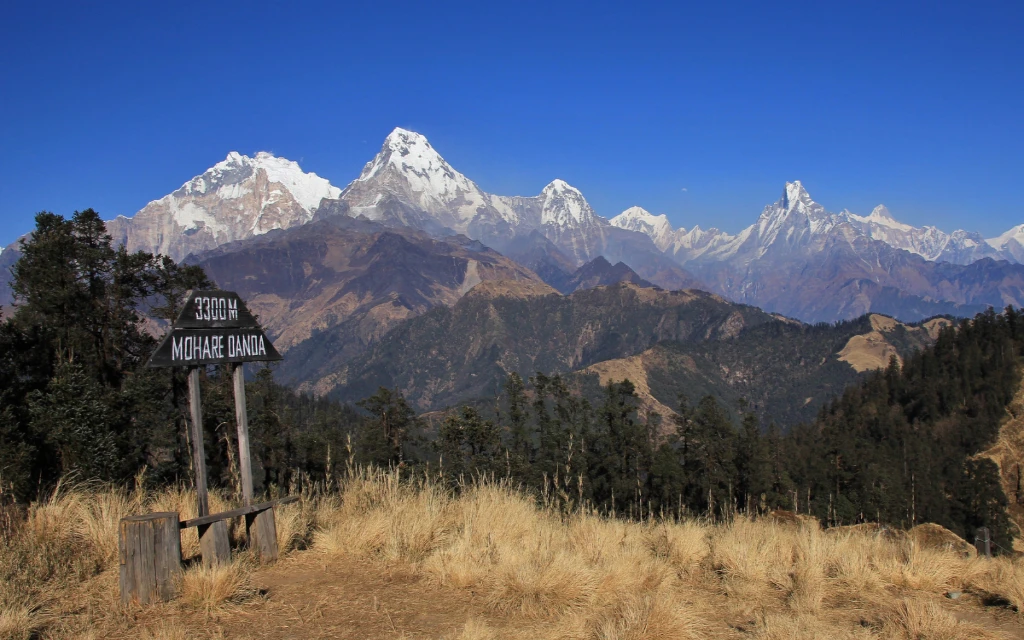
The Mohare Danda Trek is a newly discovered trail in Nepal’s Annapurna region, offering an eco-friendly alternative to mainstream treks while supporting local communities. This short yet rewarding hike leads to Mohare Danda (3,300 m), providing breathtaking panoramic views of the Annapurna and Dhaulagiri mountain ranges, including peaks like Nilgiri, Machhapuchhre, and Hiunchuli.
Designed as a community-based trekking route, the Mohare Trek empowers local villages by promoting sustainable tourism. Along the way, trekkers pass through lush rhododendron, oak, and pine forests; remote settlements; and terraced farms, experiencing the authentic culture and hospitality of the region. The trail also features stunning sunrises, sunsets, and close-up mountain vistas from Mohare Danda’s viewpoint.
The 9-day journey begins in Kathmandu, with a scenic drive to Pokhara and a jeep ride to Galeshwor. From there, the route winds through Banskharka, Nangi, and Hampal Pass before reaching Mohare Danda. The descent leads to Tilkot and Tiplyang, followed by a return to Pokhara.
By choosing the Mohare Danda Trek, travelers contribute to local economies and ecotourism, ensuring a positive impact on the region’s development.
Outline Itinerary for Mohare Danda Trek 5 Days
Day | Route | Approx. Duration | Elevation |
01 | Pokhara → Galeshwor → Banskharka | 6-7 hours (Drive + Trek) | 1,530 m (Galeshwor) → 2,250m (Banskharka) |
02 | Banskharka → Nangi Village | 5-6 hours | 2,250 m → 2,330m |
03 | Nangi Village → Mohare Danda | 6-7 hours | 2,330 m → 3,300m |
04 | Mohare Danda → Ghorepani (via Poon Hill) | 7-8 hours | 3,300 m → 2,874m (Ghorepani) |
05 | Ghorepani → Hile → Drive to Pokhara | 3-4 hours (Trek) + 2-3 hours (Drive) | 2,874 m → 1,495m (Hile) → 820m (Pokhara) |
How difficult is the Mohare Danda Trek?
The Mohare Danda Trek is rated moderate in difficulty, making it ideal for trekkers with a reasonable level of fitness and no prior high-altitude experience. Unlike some of Nepal’s more demanding trails, this route avoids extreme elevations, maxing out at 3,300 m, which drastically reduces the risk of altitude sickness. While some may experience mild symptoms like shortness of breath or fatigue, they are far less severe than on higher Himalayan treks.
Each day involves 5-6 hours of walking through a mix of forest trails, stone steps, and rolling hills, with plenty of shaded stretches thanks to lush rhododendron and oak forests. The trail is less developed than classic routes like Annapurna Base Camp, offering a more rustic and immersive experience, but basic teahouses and lodges along the way ensure comfortable stops.
Who Can Do This Trek?
- No technical skills or prior trekking experience needed.
- Able to walk 5–6 hours daily with some steep ascents/descents.
- A positive attitude and adaptability to rustic conditions go a long way!
Do I need a permit for the Mohare Trek?
Yes, you will need permits for the Mohare Danda Trek, as it falls within the Annapurna Conservation Area. The required permit for this trek is the Annapurna Conservation Area Project (ACAP) permit. The ACAP helps fund conservation efforts and sustainable tourism in the region. The permits can be obtained in Kathmandu or Pokhara through authorized agencies or the Nepal Tourism Board office. The process is straightforward, and we will usually handle it for you if you book through one of our partners. Carrying the permits is essential, as there are checkpoints along the trail where officials may verify them.
Note: If you are trekking independently, you must arrange the permits yourself, but if you are with Hiking Adventure Treks, we take care of the paperwork for you. Always carry printed copies and keep them accessible during your trek.
Which month is best for the Mohare Danda Trek?
Planning a trek in Nepal’s Annapurna region? Weather plays a key role in ensuring a safe and breathtaking experience. Nepal enjoys four distinct seasons, each offering unique trekking conditions.
Ideal Seasons: Spring & Autumn (Peak Trekking Time)
- Spring (March–May): Nature comes alive with blooming rhododendrons, lush green valleys, and mild temperatures. Skies are crystal clear, offering unobstructed views of the Annapurna and Dhaulagiri ranges.
- Autumn (September–November): Post-monsoon freshness brings stable weather, crisp air, and stunning visibility. Perfect for sunrise views from Mohare Danda and Poon Hill.
Why do most choose these seasons?
- Minimal rainfall
- Warm days & cool nights
- Best mountain visibility
- Comfortable trekking conditions
Off-Season Treks: Winter & Summer
- Winter (December–February): Cold but rewarding! Expect snow-dusted trails and fewer crowds. Higher altitudes (above 3,000m) can be chilly, but lower regions remain pleasant.
- Summer/Monsoon (June–August): Lush landscapes but slippery trails and frequent rain. Ideal for those seeking solitude and vibrant greenery.
Pro Tip: Temperatures vary drastically with altitude—layering is essential! Mornings are chilly, while daytime trekking can be warm.