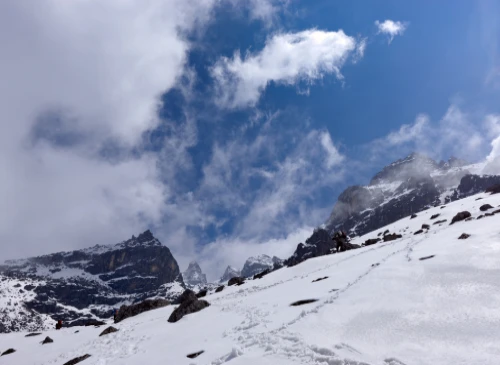
The Kanchenjunga Base Camp Trek offers a breathtaking experience in eastern Nepal. Named for the majestic Mount Kanchenjunga, the world's third-highest peak, this trek takes you to base camps on both its north and south sides, offering breathtaking views of some of the Himalayas' most stunning and unspoiled environments. The Kanchenjunga base camp hike leads to the foot of Nepal's third-highest peak and through the scenic Kanchenjunga Conservation Park.
The base camp is located at an elevation of approximately 5,143 meters (16,873 feet). From here, you'll be treated to stunning views of the towering Kanchenjunga Peak and its surrounding summits, providing a weird and one-of-a-kind experience for visitors. Those who have embarked on this magnificent trek have learned that the Kanchenjunga Base Camp Trek is more than just a journey; it’s a quest for inspiration, answers, and truth. It is an attempt to touch the heights so sublime that they exclude the very fact of human life next to them.
Major attractions of the Kanchenjunga Region
- Mount Kanchenjunga: The colossal five-peaked massif, revered as a sacred guardian deity. The North and South Base Camp treks provide staggering, close-up views of its sheer icy faces.
- Kanchenjunga Conservation Area: A UNESCO World Heritage site and biodiversity hotspot spanning over 2,035 sq km. It shelters endangered species like the snow leopard, red panda, and Himalayan black bear.
- The Lhonak Valley & Pangpema: The dramatic, high-altitude valley leading to Pangpema (North Base Camp), a vast glacial moraine offering one of the most spectacular 360-degree mountain panoramas on Earth.
- The Yalung Glacier & Oktang: The southern counterpart, where the trail culminates at Oktang, providing a breathtaking frontal view of Kanchenjunga's massive south face.
- Remote Mountain Passes: Challenges like the Sele La Pass (4,290m) and the Mirgin La Pass (4,480m) offer thrilling crossings and unforgettable vistas.
- Sacred Lakes: High-altitude gems like the Ramtang and Sinion Lakes, steeped in local mythology and surrounded by rugged peaks.
- Authenticity: The sheer lack of commercialization. Tea houses are basic and family-run, providing a genuine glimpse into high-mountain life.
The Himalayas of the Kanchenjunga Region
The Kanchenjunga massif is the centerpiece, but the region is a sprawling theater of Himalayan giants. It forms a colossal wall of snow and rock that includes peaks like Jannu (Kumbhakarna) at 7,710 m, Makalu (8,485 m) visible from certain ridges, and a host of other 7,000m+ sentinels such as Kabru, Talung, and Rathong. The topography plunges from icy summits through massive glaciers (like the Kanchenjunga and Yalung Glaciers) down to lush, subtropical valleys in just a short distance, creating some of the most dramatic vertical relief on the planet. The play of light at sunrise and sunset here, painting the peaks in hues of gold and rose, is a sight that etches itself into memory.
People and Culture of the Kanchenjunga Region
This cultural mosaic is as captivating as the landscapes. The lower valleys are inhabited by the Limbu and Rai communities, indigenous groups with rich animist traditions, vibrant festivals like Chasok Tangnam, and distinctive dance, music, and clothing. The Limbu are one of Nepal's oldest tribes, with their own language, script (Kirat-Sirijonga), and a deep connection to the land of "Pallo Kirat."
As you ascend, you enter the world of Tibetan Buddhism. The upper valleys are home to Sherpa and Tibetan communities. You’ll encounter ancient gompas (monasteries), such as in the villages of Ghunsa and Lhonak, where the air is thick with the scent of juniper incense and the sound of chanting monks. Prayer flags flutter over high passes, and mani walls inscribed with sacred mantras line the trails. The region’s spirituality is palpable, centered on the reverence for Kanchenjunga as "The Five Treasures of the Great Snow," a sacred abode of gods.
How to get to the Kanchenjunga Region?
Reaching Kanchenjunga is an adventure in itself, requiring time and planning.
- International Arrival: Fly into Kathmandu's Tribhuvan International Airport (KTM).
- Domestic Flight to a Gateway: From Kathmandu, take a domestic flight to Biratnagar or Bhadrapur in the southeastern Terai.
- The Road Journey: This is the long part. From Biratnagar/Bhadrapur, it's a full day's drive (often in a 4WD jeep) to the roadhead towns that mark the trek's start.
- For the North Base Camp trek, the starting point is Taplejung (via Suketar).
- For the South Base Camp trek, you often begin from Phidim/Taplejung or Hile.
- Permits: This is a restricted area. You must obtain:
- Kanchenjunga Restricted Area Permit (RAP): Requires booking through a registered Nepali trekking agency and a minimum of two trekkers with a licensed guide.
- Kanchenjunga Conservation Area Permit (KCAP).
- Important: Independent trekking is not permitted. You must be part of an organized trek with a guide.
Trekking Routes of Kanchenjunga
There are two primary routes, often combined into one epic circuit (requiring 18-24 days).
- Kanchenjunga North Base Camp Trek (Pangpema):
Highlights: Follows the Tamur and Ghunsa River valleys through rhododendron forests to the picturesque Sherpa village of Ghunsa. Continues to the dramatic Lhonak Valley and finally to Pangpema, the North Base Camp. The view of Kanchenjunga's north face from here is utterly monumental.
- Kanchenjunga South Base Camp Trek (Oktang):
Highlights: A greener, lusher trail through terraced farms and dense forests to Yamphudin, crossing the challenging Sinion La. Leads to the Yalung Glacier and the terminus at Oktang, directly beneath the stunning, complex south face of Kanchenjunga.
- The Kanchenjunga Circuit Trek:
The Ultimate Experience: This links both north and south base camps. It typically involves trekking to the North Base Camp first, crossing the high Lapsang La or Mirgin La passes, and descending to the southern route. It’s a demanding but incomparably rewarding journey that showcases the full diversity of the region.