Gokyo Ri vs. Kalapatthar for Sunrise
Before we pit these two titans against each other, let's get to know them individually. Both are best in their own right, but they offer distinctly different personalities and stories.
Kalapatthar (5,644m): The Classic Everest Vantage Point
Kalapatthar, which means "Black Rock" in Nepali, is the undisputed, classic heavyweight. This isn't just a hill; it's a pilgrimage for anyone whose heart beats for the world's tallest mountain. Perched above the iconic Gorak Shep, its entire purpose is to deliver you face-to-face with the sheer, icy, awe-inspiring North Face of Mount Everest.
Think of Kalapatthar as the intense, focused specialist. The journey to its summit is often the climax of the classic Everest Base Camp trek, a grueling pre-dawn push in biting cold, headlamps bobbing in the dark, driven by a singular goal. From its rocky pinnacle, the view is direct, dramatic, and deeply personal. You are not just seeing Everest; you are staring into the heart of the Khumbu Icefall, tracing the lines of the South Col route, and watching the first light ignite the summit pyramid in a blaze of alpenglow. It is an intimate, powerful, and almost overwhelming audience with the mountain itself.
Gokyo Ri (5,357m): The Turquoise Lake & Panorama King
Now, meet Gokyo Ri. If Kalapatthar is the specialist, Gokyo Ri is the charismatic polymath. It is not just about one mountain; it’s about the whole damn party. This peak offers a 360-degree visual symphony that is, in my humble opinion. It is the most spectacular single-view panorama in all of Nepal.
Here’s the magic: while you absolutely get a breathtaking, slightly more oblique view of Everest (peeking gloriously over the Nuptse-Lhotse wall), you also get a front-row seat to a staggering lineup. To the north, the colossal, broad-shouldered Cho Oyu (the world’s 6th highest) feels close enough to touch. Then, your gaze sweeps past Everest to Lhotse, Makalu, and even distant Kangchenjunga on a clear day. You will see four of the planet’s fourteen 8,000-meter giants in one sweeping glance. Below, the electric blue-green Gokyo Lakes chain snakes through the valley like a spilled necklace. The experience is less of an intense stare-down and more of a joyful, open-armed embrace of the entire Himalayan expanse.
Sunrise Spectacle & The View From The Top
Let’s cut to the chase. You are dragging yourself out of a warm sleeping bag at 3 AM, fumbling with headlamps in the bitter, thin air, all for one transcendent moment: the sun kissing the roof of the world. But the character of that moment couldn’t be more different depending on your chosen throne.
Kalapatthar: The Intimate Everest Drama
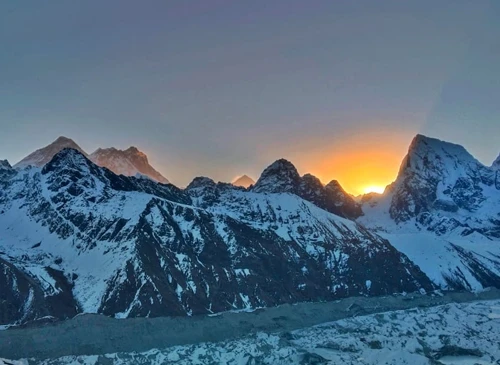
Standing on the rocky, wind-scoured summit of Kalapatthar feels like being ushered into a private, vertical theatre. The stage is set with one undeniable star: Mount Everest. From here, you don't just see the summit; you witness the entire, brutal architecture of the world’s highest mountain. The first pre-dawn light begins as a soft blush on the summit pyramid, then explodes into a blazing, golden inferno that cascades down the infamous Khumbu Icefall, Nuptse’s razor-edged wall, and Lhotse’s immense face. It’s a close-up, dramatic, and intensely focused performance. You can almost feel the mountain's breath. The view is southwest-facing, meaning the sunrise hits Everest directly, creating a powerful, almost personal, connection. It’s raw, it’s iconic, and it answers the primal call of every trekker who has ever dreamt of standing in the shadow of the Great One.
Gokyo Ri: The Grand Himalayan Panorama
Gokyo Ri is a breathtaking symphony where you will get to see panoramic mountains, including Everest. Your 360-degree vantage point is the undisputed champion of panoramic grandeur. As dawn breaks, the light doesn’t play on just one giant but on a staggering lineup. Everest, Lhotse, Makalu, and Cho Oyu are four of the planet’s fourteen 8,000-meter peaks, arrayed like titans across the horizon. The sunrise here is a spectacle of scale and color, painting the entire sky in pastel hues that reflect off the jewel-like turquoise of the Gokyo Lakes far below. You don’t just look at a mountain; you survey a kingdom. The view north, across the Ngozumpa Glacier (the largest in the Himalayas), feels like gazing at a frozen, ancient river of time. It’s less of an intimate portrait and more of a sweeping, humbling landscape painting where you are both the audience and a tiny, awestruck part of the canvas.
Trekking Difficulty & Accessibility
Let's get real for a moment: neither of these sunrise viewpoints is a casual morning stroll. You’ll be climbing well above 5,000 meters in the dark, pre-dawn cold, and the air will be thin enough to make every step feel deliberate. But the journey to each summit is a different beast entirely, and understanding this can make or break your experience.
First, let’s talk trail conditions and the typical approach. Kalapatthar is almost always attempted from Gorak Shep, the last teahouse settlement on the classic Everest Base Camp trek. This is a brutal advantage. You are already shattered from hiking to EBC the previous afternoon; you’re sleeping at 5,164 m, where rest is elusive. You will drag yourself out of your sleeping bag around 4 AM for a steep, 1.5-2 hour grind up a rugged, boulder-strewn slope. The path is well-trodden and obvious, but it’s relentlessly uphill. The mental game here is fierce—you are running on fumes for a legendary payoff.
The climb up Gokyo Ri, in contrast, usually starts from the shores of the stunning Gokyo Lakes themselves. You’re sleeping in the village of Gokyo (4,750m), which, while still high, is notably lower than Gorak Shep. The ascent is steeper in sections, a relentless series of switchbacks that zig-zag directly up the hillside from the village. It’s shorter, typically a 1.5-hour push, but don’t let that fool you; it’s a thigh-burner. The trail is less rocky underfoot than Kalapatthar but demands consistent, steep effort from the first step.
This leads perfectly into altitude and acclimatization, the silent dictator of Himalayan trekking. Here, Gokyo Ri often holds a crucial advantage. The entire Gokyo Valley trek is renowned as one of the best acclimatization routes in the Everest region. The approach to Gokyo involves more gradual altitude gain and the side trip to the Fifth Lake or Scoundrel's Viewpoint are perfect, less-crowded acclimatization hikes. By the time you summit Gokyo Ri, your body has had a better chance to adapt. Kalapatthar, however, is the grand finale of the faster, more direct EBC trek. Acclimatization days are built-in, but the trail is busier and the final push to Gorak Shep feels more rushed for many trekkers.
So, which is physically more demanding?Kalapatthar wins for overall physiological strain. You are higher, you feel the altitude more acutely, and you’re attempting it at the tail end of a longer, more exhausting journey. The summit morning is a test of pure will. Gokyo Ri is more about cardiovascular and muscular challenge. It is a shorter, steeper vertical climb where the burn in your legs is the primary battle, not just the thin air. For many, this makes the Gokyo Ri ascent feel more "actively difficult" but perhaps slightly less grueling overall than the Kalapatthar experience.
Whichever path you choose, remember: the mountain sunrise is never earned easily. But knowing the nature of the climb ahead—the rocky trudge versus the steep switchback, the altitude game versus the leg-burning sprint—is the first step in preparing your mind and body for the incredible dawn that awaits.
The Journey & Overall Experience
In the Himalayas, the journey truly is the destination. The path you choose to your sunrise showdown, the villages you sleep in, the trails under your boots, and the atmosphere you absorb, all shape your entire Everest region story. This is where the Kalapatthar and Gokyo Ri experiences diverge dramatically.
Choosing the Everest Base Camp trail to Kalapatthar means walking the legendary, storied highway to Everest. The energy is palpable, a mix of determined trekkers, laden yaks, and the shared dream of touching the sky near the world's highest peak. You will sip tea in bustling Namche Bazaar, weave through the spiritual gates of Tengboche Monastery, and feel the anticipation build alongside the crowds as you approach Gorak Shep. This route is about being part of a pilgrimage. The sunrise ascent of Kalapatthar is the triumphant, if grueling, climax of that journey, often shared with dozens of others, all sharing in the collective, shivering awe as the first light hits Mount Everest's formidable Khumbu Face. It's communal, iconic, and undeniably epic.
In stark contrast, the path to Gokyo Ri unfolds in the serene Gokyo Valley, a strong contender for the most beautiful trek in Nepal. After branching off at Namche, the crowds thin, the pace slows, and a profound quiet settles in. Your soundtrack becomes the murmur of streams and the crunch of your own boots. The reward each day isn't just a higher elevation but the breathtaking, milky-turquoise beauty of the Gokyo Lakes, a string of sacred, shimmering jewels set between colossal peaks. Your sunrise climb feels more personal, more meditative. Standing atop Gokyo Ri, with the sun igniting not just Everest but also Cho Oyu, Lhotse, and Makalu in a 360-degree fire. You are likely to have more space for your thoughts and your tripod. It’s an experience that balances grandeur with intimacy, where the majestic Himalayan sunrise views are complemented by the tranquil journey.
At Last: Gokyo Ri vs. Kalapatthar for Sunrise
After weighing the awe-inspiring views, the physical demands, and the soul of each journey, you’re likely still wondering: “But which one is for me?” Let’s cut to the chase. This isn't just about altitude or checklists; it's about which experience will resonate with your spirit long after your boots are unpacked. While both are life-changing, if I had to place my bet on the more profound, all-encompassing, and visually staggering experience, I’d lean decisively toward Gokyo Ri.
Choose Gokyo Ri if... you crave a symphony of landscapes and a deeper sense of solitude.
This is my personal recommendation for trekkers seeking a richer tapestry. The sunrise here isn’t a solo performance; it’s an orchestral masterpiece. Yes, you see Everest, but it’s framed by a panoramic cast that includes Cho Oyu, Lhotse, and Makalu—a staggering quartet of giants. The dawn light doesn’t just hit one peak; it ignites a chain of mountains, then spills down to set the jewel-like Gokyo Lakes ablaze in turquoise and gold far below you. You trade the icy, rocky drama of the Khumbu for a vista of surreal, high-altitude color and scale. The walk along the Gokyo Valley to get there is quieter, more serene, and offers a different pace than the busier EBC trail. For me, this combination of 360-degree Himalayan views, stunning lake scenery, and a greater sense of peaceful discovery makes Gokyo Ri the more rewarding holistic adventure.
So, is Gokyo Ri "better" than Kalapatthar?
"Better" is subjective, but for the trekker who values panoramic grandeur, a unique blend of ice and azure water, and a slightly less-trodden path, Gokyo Ri provides a more diverse and emotionally stirring spectacle. It’s the choice for the wanderer who wants to see Everest not just as a solitary trophy, but as the brilliant centerpiece in a wider, wilder Himalayan gallery. Kalapatthar fulfills a specific, iconic dream. Gokyo Ri often surpasses expectations, creating a broader, more unexpected dream you never knew you had.
.webp)